Roller-Compacted Concrete
Roller-Compacted Concrete (RCC) in Central Alberta
High-strength concrete placed and compacted on your site at 30 MPa. RCC goes down fast, opens to traffic sooner, and takes the kind of beating that feedlots, laydown yards, and haul roads dish out, which is why it is our flagship pour.
What it is
What is roller-compacted concrete?
Roller-compacted concrete uses the same ingredients as conventional concrete (cement, water, aggregate, and sand) but mixed much drier to a stiff, zero-slump consistency. It looks like damp gravel and holds its shape under a roller.
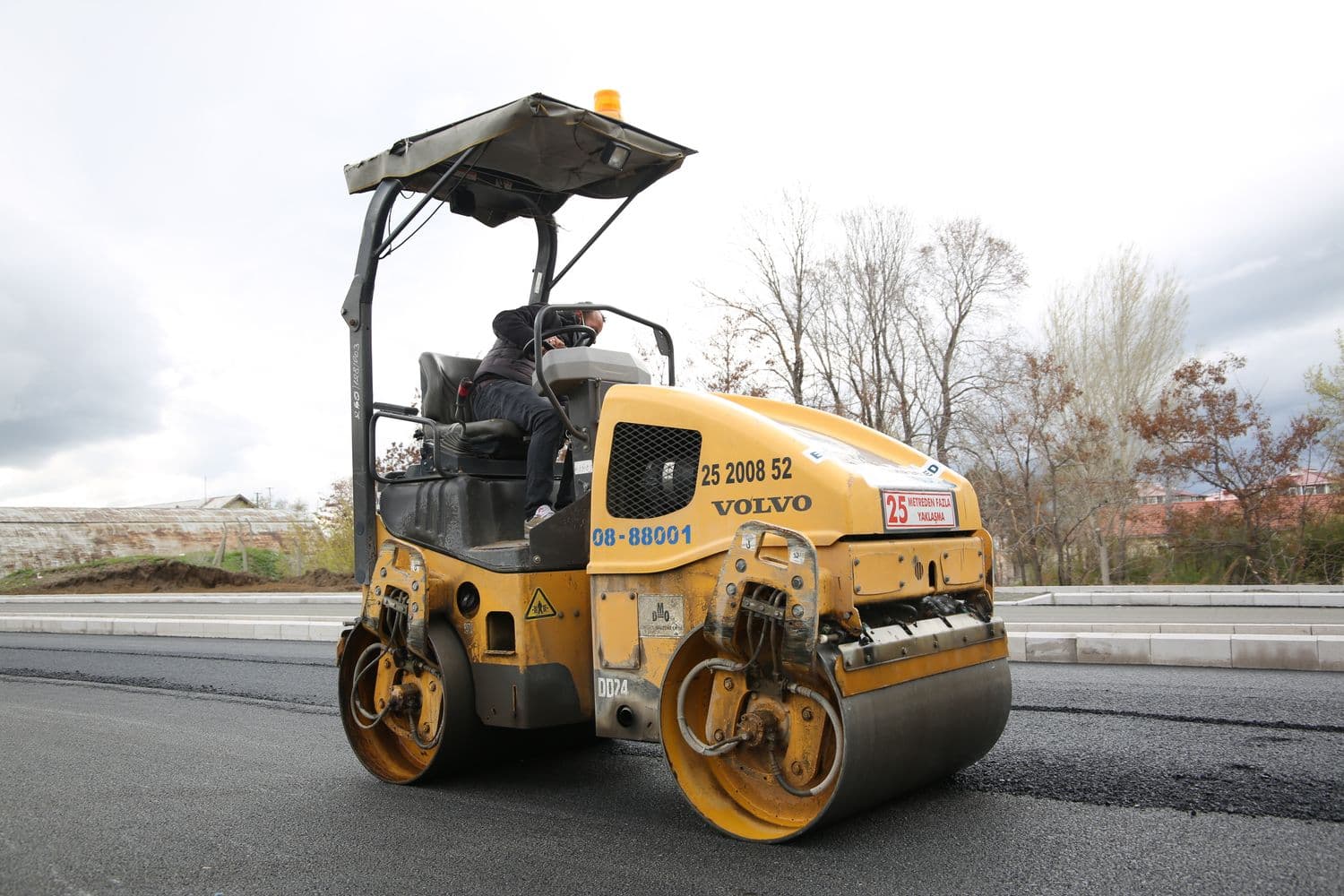
Instead of being poured like a sidewalk, RCC is placed like asphalt: spread with paving equipment, then compacted with vibratory rollers. There are no forms, no rebar, and no hand-finishing, and that is exactly where the time and cost savings come from.
The result is concrete-level strength and toughness with the placement speed of asphalt paving: a dense, zero-slump surface built to carry real load on a working site.
Why RCC
Why contractors
and farms choose RCC
Four things make RCC the right call when a surface has to carry weight and get back to work fast.
Compressive strength
Roller-compacted, 28-day
Poured to 30 MPa
Our standard RCC mix runs 30 MPa, concrete-level strength that sits squarely in the normal RCC range, built to hold up under loaders, grain trucks, and constant traffic.
Back in service in ~24–48 hrs
Strength in RCC comes from compaction, not a long finishing cure, so surfaces can typically carry traffic and heavy equipment within about a day or two of placement.
~25–30% less than conventional
With no forms, no rebar, and no hand-finishing, RCC is commonly around 25–30% cheaper to install than conventional concrete paving, and competitive with asphalt.
Built for heavy load + freeze-thaw
A dense, low-permeability surface that stands up to rutting, repeated heavy loads, fuels and oils, and Alberta freeze-thaw, with very low long-term maintenance.
Where it fits
Where RCC is used
Anywhere a surface takes heavy, repeated load and has to keep working. A few of the places we place it:
Industrial yards
- Heavy equipment + laydown pads
- Loading docks and aprons
- Container and storage yards
Farm + feed
- Feed pads and bunker storage pads
- Grain and commodity pads
- Machinery and equipment yards
Access + haul
- Access and haul roads
- Ramps and turn lanes
- High-traffic surfaces
The pour
How we place RCC on your site
No forms, no finishing crew standing around. RCC is graded, placed, and rolled in one tight sequence: most of the speed lives here.
- 01
Grade the sub-base
We start with a stable, well-compacted sub-base. RCC carries load by spreading it through a dense section, so uniform support under the slab is where a lasting job begins.
- 02
Place the stiff mix in lifts
The zero-slump mix (it looks like damp gravel) is spread in compacted lifts, roughly 4 to 10 inches, with paving equipment rather than poured into forms.
- 03
Compact to density
Vibratory rollers compact each lift immediately. Density is strength in RCC, so we roll to a target density right after placement, not hours later.
- 04
Cure and saw-cut joints
We cure to lock in strength and saw-cut control joints where needed, so any shrinkage cracking follows the joint line and the surface stays tight.
The fine print
Roller-compacted concrete FAQs
Straight answers to what contractors and farm operators ask us most about RCC.
Yes. Roller-compacted concrete reaches concrete-level strength, commonly in the range of about 28 to 41 MPa, and our standard mix is poured to 30 MPa, built for heavy loads. It carries the same kind of traffic as conventional concrete pavement.
Often within about 24 to 48 hours. RCC gets its strength from compaction rather than a long finishing cure, so a yard or pad can typically be back in service much sooner than a conventional poured slab.
Against conventional concrete, RCC gives you similar durability and load capacity at a lower installed cost, typically around 25 to 30% less, because there are no forms, no rebar, and no hand-finishing. Against asphalt, it lasts longer and needs far less maintenance: no seal-coating or resurfacing.
RCC has a tighter, more textured surface than a broom-finished slab. It is built for function and load, not an architectural finish. If you need a smoother surface for a particular use, tell us what is going on it and we will talk through the options.
All concrete shrinks as it cures. We manage that with saw-cut control joints that direct any cracking to clean lines and keep the surface tight. Proper base prep, mix, and jointing are what keep an RCC surface predictable.
A dense, low-permeability RCC surface stands up well to freeze-thaw, which matters in central Alberta. Proper mix design and curing are key, and that is exactly what the pour is built around.
Request a quote
Need a roller-compacted pour?
Send the job and we will quote it. Site visits across central Alberta, no online prices, no obligation.